Q. 100 coins are tosses together find the probability of getting heads odd no. of times
Thursday, 21 April 2016

Sunday, 17 January 2016
DIMENSIONS
Dimensions
When a derived
quantity is expressed in terms of fundamental quantities, it is written as a
product of different powers of the fundamental quantities. The powers to which
fundamental quantities must be raised in order to express the given physical
quantity are called its dimensions.
Here the
physical quantity that is expressed in terms of the basic quantities is
enclosed in square brackets to indicate that the equation is among the
dimensions and not among the magnitudes.
Thus equation
(i) can be written as [force] = [MLT2].
Such an
expression for a physical quantity in terms of the fundamental quantities is
called the dimensional equation. If we consider only the R.H.S. of the
equation, the expression is termed as dimensional formula.
Thus,
dimensional formula for force is [MLT–2].
Thursday, 7 January 2016
Monday, 14 September 2015
PROBABILITY
In our daily life, we often used phrases such as 'It may rain today', or 'India may win the match' or ' I may be selected for this post.' These phrases involve an element of uncertainty. How can we measure this uncertainty ? A measure of this uncertainty is provided by a branch of Mathematics, called the theory of probability.
Probability Theory is designed to measure the degree of uncertainty regarding the happening of a given event. The dictionary meaning of probability is ' likely though not certain to occur. Thus, when a coin is tossed, a head is likely to occur but may not occur. Similarly, when a die is thrown, it may or may not show the number 6.
Probability Theory is designed to measure the degree of uncertainty regarding the happening of a given event. The dictionary meaning of probability is ' likely though not certain to occur. Thus, when a coin is tossed, a head is likely to occur but may not occur. Similarly, when a die is thrown, it may or may not show the number 6.
Sunday, 18 May 2014
Mathematics Fact


1. Jean Robert Argand (1768-1822) was Swiss Mathematician who publish the idea of geometrical representation of complex number known as Argand Diagram
Wednesday, 30 April 2014
combinational logic
In digital circuit theory, combinational logic (sometimes also referred to as time-independent logic) is a type of digital logic which is implemented by Boolean circuits, where the output is a pure function of the present input only. This is in contrast to sequential logic, in which the output depends not only on the present input but also on the history of the input. In other words, sequential logic has memory while combinational logic does not.
Tuesday, 8 April 2014
DIGITAL ELECTRONIC
QS.1(i)
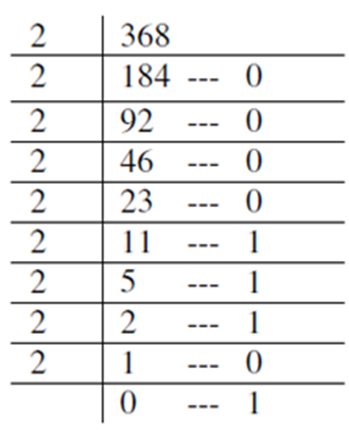
What is the binary equivalent of the decimal number (368)10
Ans.
QS.1(ii)
The decimal equivalent of hex number 1A53 is
Ans.
The decimal equivalent of Hex Number 1A53 is 6739
(Conversion from Hex Number to Decimal Number is
given below)
1 A 5 3 Hexadecimal
16³ 16² 16¹ 16° Weights
(1A53)16 = (1X16³) + (10 X 16²) + (5 X 16¹) + (3 X
16º)
= 4096 + 2560 + 80 + 3
= 6739
QS.2
The simplification of the Boolean expression (ABC)+ (ABC) is
Ans. The Boolean expression is (ABC)+ (ABC)
is equivalent to 1
(ABC)+ (ABC) = A + B +C
+ A + B +C = A + B + C + A + B + C
= (A+ A )(B+ B )(C+C ) = 1.1.1
= 1
QS.3The
Gray code for decimal number 6 is equivalent to?
Ans.
The Gray code for decimal number 6 is equivalent to 0101
Decimal number 6 is equivalent to binary number is
0110
.png)
QS.4.
Simplify the following expression into sum of products using Karnaugh map
F(A,B,C,D) = _(1,3,4,5,6,7,9,12,13).
Ans.
Simplification of the following expression into sum of products using Karnaugh
Map:
F(A,B,C,D) = S (1,3,4,5,6,7,9,12,13)
Karnaugh Map for the expression F(A,B,C,D) = S
(1,3,4,5,6,7,9,12,13)
is shown in Fig.5(a). The grouping of cells is also
shown in the Figure.
.png)
Fig.4(a)
QS.5
Simplify and draw the logic diagram for the given expression
F = ABC+ ABC+ ABC+ ABC+ ABC.
Ans.
Simplification of the logic expression
F = ABC + AB C + ABC + A
BC + A B C
F = ABC + AB C + ABC + A
BC + A B C
F = A + B +C + ( A + B
)C + ABC + A ( B +C ) + A B C
(Q ABC = A + B +C and AB
= A + B by using Demorgan’s Law)
= A + B +C + AC + B C
+ ABC + A B + AC + A B C
= A + AC+ B + B C +C +
AC + ABC +A B + A B C
= A (1+C)+ B (1 + C) +C (1 + A)
+ ABC + A B + A B C
= A + B +C + ABC +
A B + A B C {Q (1+C) = 1 and (1+A) = 1}
= ( A + A B ) + B (1 + AC) +C
(1+ AB)
= ( A + B )+ B +C {Q ( A
+ A B ) = ( A + B ); (1+AC) = 1 and (1+ AB) =1}
F = ( A + B +C ) (Q B + B
= B )
The logic diagram for
the simplified expression F = ( A + B +C ) is given in
fig.6 (a)
.png)
Fig.5(a) Logic diagram for the
expression F = ( A + B
+C
)
Important Questions on DIGITAL & ANALOG COMMUNICATION
Q1. Effect of Limited Bandwidth
on Digital Signal. Explain.
Q2. Define and explain Shannon
limit theorem.
Q3. Discuss different
communication modes. Differentiate between asynchronous and synchronous
transmission.
Q4. Difference between Secret
key cryptography and public Key cryptography.
Q5. Explain with diagram
different components of a communication system.
Q6. Explain properties of
Fourier transform.
Q7. If f(t)-F(w) is Fourier
transform pair. Find the Fourier transform of the following:
(i) f(t) coswot (ii) f2(t) (iii) F(-2t)
Q8. Explain the two physical
layer interfaces i.e., RS232 and X.21
Q9. The bit sequence 1011101011
is to be transmitted using formats:
i) Unipolar RZ & NRZ
ii) Bipolar RZ & NRZ
Q10. Explain different
transmission media:
(i) Fiber Optics (ii) Twisted
pair (iii) Coaxial Pair
Q11. Explain following terms:
(i) Nyquist rate (ii)Shannon
Limit
Q12. Differentiate between TDM
and WDM.
Q13. Explain ISDN with
applications, advantages & Disadvantages.
Q14. Differentiate between
circuit switching and packet switching systems.
Q15. Explain the sliding window
protocol in detail.
Q16. Explain the following:
(i) Data compression (ii) Run
Length encoding
Q17. Draw and explain the basic
block diagram of communication system.
Q18. What are the properties of
signal? Compare analog signal and digital signal.
Q19. What are ESD and PSD?
Derive expression for both.
Q20. Explain error detection
and parity check.
Q21. Define Modulation:
Amplitude, Phase and frequency.
Q22. Differentiate between
connection oriented and connectionless service.
Q23. What are transmission
impairments?
Q24. Explain Huffman encoding
with the help of example.
Q25. Describe PSTN.
Sunday, 10 November 2013
Saturday, 26 October 2013
Subscribe to:
Posts (Atom)